
If you run a business where employees are exposed to dust, fumes, chemicals, or other hazardous substances, you will have heard the term CoSHH. But what does CoSHH compliance actually mean in practice – and what do you need to do to meet your legal obligations?
What Is CoSHH?
CoSHH stands for the Control of Substances Hazardous to Health Regulations 2002. It is the primary piece of UK health and safety legislation governing how employers must manage the risks posed by hazardous substances in the workplace.
CoSHH covers a wide range of substances, including:
- Dusts – wood dust, flour dust, silica dust, metal dust
- Fumes – welding fume, soldering fume, engine exhaust
- Vapours and gases – solvents, adhesives, cleaning agents
- Biological agents – bacteria, fungi, and other micro-organisms
- Nanotechnology particles
If a substance is capable of causing harm to health through inhalation, skin contact, ingestion, or injection, it is likely to fall within the scope of CoSHH.
What Does CoSHH Require Employers to Do?
CoSHH places a series of duties on employers. These must be addressed in a structured, documented way and are not simply a matter of good practice – they are legal requirements.
- Assess the Risk
The first step is to identify all substances hazardous to health present in your workplace, and to assess the risk they pose to your employees. This CoSHH risk assessment must consider the nature of the substance, how it is used, the quantity involved, how workers might be exposed, and who is at risk. - Prevent or Adequately Control Exposure
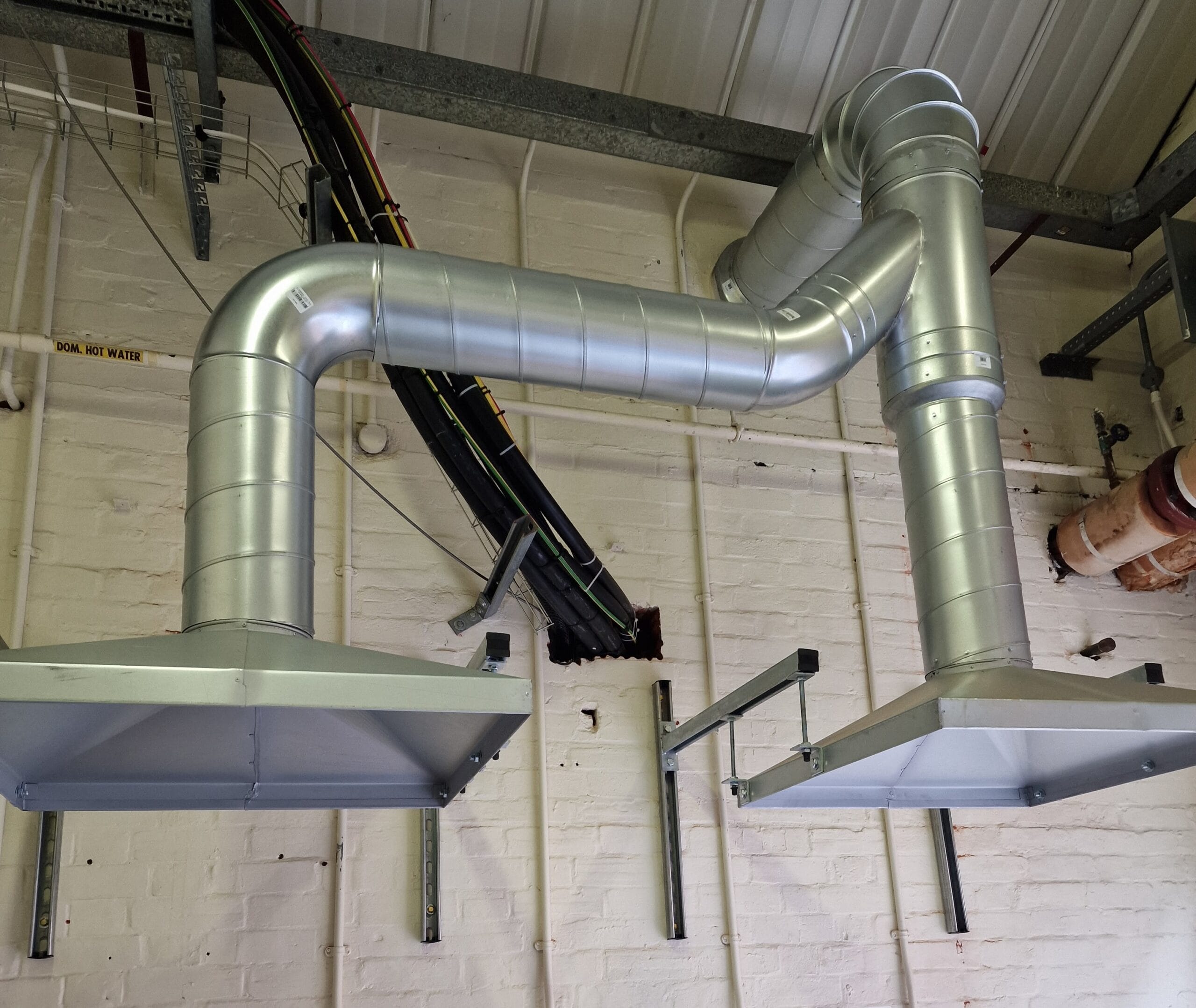
Where exposure to a hazardous substance cannot be prevented entirely, it must be adequately controlled. CoSHH sets out a hierarchy of controls, with elimination of the substance at the top and personal protective equipment (PPE) at the bottom. Local Exhaust Ventilation (LEV) sits high in this hierarchy as an engineering control that removes contaminants at source. - Ensure Control Measures Are Used and Maintained
It is not sufficient simply to install an LEV system. CoSHH requires that control measures are properly used, maintained in efficient working order, and kept in good repair. Employees must be trained to use them correctly. - Monitor Exposure
In some circumstances – particularly where there is a risk of exposure to substances with a Workplace Exposure Limit (WEL) – employers must monitor the level of exposure their employees experience. This may involve air sampling and analysis. - Carry Out Health Surveillance
Where employees are exposed to substances known to cause occupational disease – such as hardwood dust, isocyanates, or certain metalworking fluids – health surveillance may be required. This typically involves periodic medical examinations or lung function tests. - Inform, Instruct and Train Employees
Employees must be given information about the substances they work with, the risks they pose, and how to use control measures correctly. This training must be appropriate and kept up to date.
How Does LEV Testing Fit Into CoSHH Compliance?
Regulation 9 of CoSHH specifically addresses the maintenance, examination, and testing of engineering controls. It requires that any LEV system used to control exposure to hazardous substances must be:
- Maintained in efficient working order and good repair
- Thoroughly examined and tested at least every 14 months by a competent person (BOHS P601-qualified engineer)
- Documented – records of all examinations and tests must be kept for at least five years
This means that having an LEV system installed is only part of your CoSHH obligation. Regular, documented testing by a qualified engineer is a separate legal requirement.
What Substances Have Workplace Exposure Limits?
The HSE publishes a document called EH40, which sets out the Workplace Exposure Limits (WELs) for hundreds of substances. A WEL is the maximum concentration of a substance in workplace air, averaged over a specified time period, to which workers may be exposed.
Some of the most commonly encountered substances with WELs in industrial settings include:
- Wood dust (hardwood): 3 mg/m³ (8-hour TWA) – classified as a carcinogen
- Respirable crystalline silica: 0.1 mg/m³ (8-hour TWA)
- Welding fume: 1 mg/m³ (8-hour TWA) – classified as a carcinogen
- Flour dust: 10 mg/m³ inhalable, 3 mg/m³ respirable (8-hour TWA)
Exceeding these limits is a breach of CoSHH, and an effective LEV system – regularly tested and maintained – is the primary means of keeping exposure below them.
Common Mistakes Businesses Make With CoSHH Compliance
Many businesses fall short of full CoSHH compliance without realising it. Common pitfalls include:
- Having an LEV system installed but never having it formally tested
- Allowing the 14-month LEV test interval to lapse
- Not keeping records of LEV inspections
- Relying on PPE (such as dust masks) as the primary control measure, when engineering controls should come first
- Failing to update CoSHH risk assessments when processes or substances change
Need Help With CoSHH Compliance?
Apex LEV Services provides BOHS P601-certified LEV testing across the South West and nationwide, helping businesses meet their CoSHH obligations with confidence. We provide fully documented inspection reports that satisfy HSE requirements and give you the evidence of compliance you need.